
Risk 5:
Inadequate Inverter Performance and Modeling
HIGH RISK


Risk Overview
Description:
Inverter-Based Resources (IBRs), such as wind, solar, and battery storage, respond to grid fluctuations via programmed software controls rather than the physical momentum of traditional rotating generators. Because this technology is still maturing, the industry is actively learning how to integrate high volumes of IBRs on the distribution system without compromising reliability of the interconnected bulk power system. This challenge extends to large electronic loads like data centers, which also use inverters to connect to the grid and can destabilize the system if they unexpectedly disconnect during a disturbance.
The primary risk lies in modeling gaps—if the programmed behavior of these inverters is modeled incorrectly, planning assessments will fail to predict how the grid will actually perform under stress—and performance of IBRs during grid disturbances. When aggregated, these issues can lead to the sudden loss of power supply or demand, resulting in unstable and insecure grid operations.
Key Drivers and Trends:
The primary driver of this risk is the fundamental shift in grid architecture as traditional power plants retire and are replaced by Inverter-Based Resources (IBRs). Unlike legacy generators, IBRs use high-speed electronic responses that are difficult to coordinate with slower physical systems, especially when multiple units are clustered together. While individual IBRs are small, their combined behavior can trigger large-scale reliability issues, a problem compounded by the fact that their settings can be changed remotely without a grid operator’s knowledge.
This risk is compounded by a knowledge gap within the industry. Because grid-scale inverter technology is still maturing, many developers and manufacturers lack deep familiarity with utility operations, leading to equipment that may not respond well to abnormal conditions. Furthermore, the industry currently lacks both the sophisticated power system models and the specialized expertise required to accurately predict and manage how these complex digital resources will behave during grid disturbances.
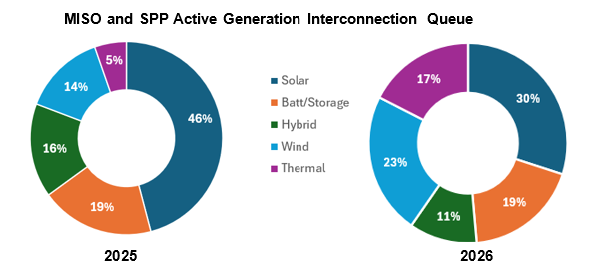
The figure below shows the breakdown of generation types within the MISO and SPP queues between 2025 and 2026. You can see a notable shift toward thermal resources (increasing from 5% to 17%) in 2026, while solar requests dropped significantly (from 46% to 30%) due to the sunsetting of federal tax incentives. Despite the recent rise in thermal generation (primarily natural gas), Inverter-Based Resources (wind, solar, and battery) still dominate 83% of the total queue, cementing their role as the primary future energy source for the region.

Event History
A North American Electric Reliability Corporation (NERC) report indicated in July 2024 that several large data centers disconnected from the grid following a disturbance that resulted in 1500 MW of load loss. The loss of load increased grid frequency and voltage, but not high enough to cause a reliability concern. Manual operation was needed to reduce system voltage within normal levels.
The Electric Reliability Council of Texas (ERCOT) experienced several events between 2023 and 2025 where large crypto-mining facilities disconnected from the grid following a disturbance. The loss of load have ranged between 100-450 MW. Causes of the disconnections varied, and none resulted in severe reliability impacts.
Since 2016, there have been 13 events involving the loss of IBR following a grid disturbance. The Blue Cut Fire disturbance was the first reported event in August 2016 and resulted in loss of 1,200 MW of IBR. NERC published actions and recommendations following this event, yet subsequent events occurred over the next six years.
In 2021 and 2022, there were two events near Odessa, Texas that resulted in a loss of 1,148 MWs and 1,711 MWs, respectively. Actions were taken by IBR owners after the first event to reduce the likelihood of recurrence, however, the second event resulted in a greater loss of MW output despite those actions.
Actions to Reduce Risk:
NERC is implementing a three-year FERC-approved work plan to identify and register bulk power system-connected IBR owners and operators. This is a three-year project that started in May 2023 and is scheduled to be completed in May 2026. The purpose of this initiative is to address a reliability gap associated with bulk power system-connected IBR resources that are currently not registered with NERC or required to comply with NERC standards
The following mandatory NERC Reliability Standards exist, or are under development, to help address this risk:
|
NERC Standard(s) and Projects |
Mitigation Activities |
|---|---|
|
TPL-001-5.1 (Transmission System Planning Performance Requirements) |
Establishes transmission system planning requirements for the bulk power system to ensure reliable operation across a wide range of system conditions and potential system contingencies. The standard is minimally effective at reducing IBR risk because the technology is new, there is limited performance data, and current models are not required to incorporate DER performance |
|
MOD-032-1 (Data for Power System Modeling and Analysis) |
Establishes modeling data requirements to support analysis of bulk power system reliability. This standard does not recognize the uniqueness of IBR modeling for the same reasons mentioned above, which limits its effectiveness |
|
PRC-024-3 (Frequency and Voltage Protection Settings) |
Sets requirements for generating resources to remain connected to the system during disturbances. Because IBR performance requirements are not defined in this standard, it is very limited in reducing IBR risk. To address this limitation, NERC developed modifications to the standard as part of Project 2020-02, which is reviewed below. |
|
PRC-028-1 (Disturbance Monitoring and Reporting Requirements for IBRs) |
Supplements PRC-002 by specifying IBR requirements to have adequate data to evaluate IBR performance during disturbances and to provide data to validate IBR models. |
|
PRC-029-1 (Frequency and Voltage Ride-through Requirements for IBRs) |
Supplements PRC-024 by specifying IBR requirements to remain connected to the system during and after frequency and voltage disturbances. |
|
PRC-030-1 (Unexpected Inverter-Based Resource Event Mitigation) |
Requires Generator Owners to identify, analyze, and mitigate events similar to what has been experienced since 2016. It places accountability for the performance of IBR(s) on Generator Owners and increases awareness of the frequency and volume of issues experienced with IBRs on the bulk system, as well as steps taken to address these issues. |
|
Milestone 3 Projects |
|
|
Project 2020-06 Verification of Models and Data for Generators |
Addresses the verification and validation of models for IBRs in a modified version of MOD-026-2. Final ballot for this standard concluded on October 24, 2025, and it was sent to the NERC Board of Trustees for approval. |
|
Requires a system-level model verification and validation against actual behavior during disturbances in a modified version of MOD-033-3. Final posting of this standard concluded on October 14, 2025, and it was sent to the NERC Board of Trustees for approval. |
|
|
Develops a model library for IBRs that NERC will maintain with generic IBR model types. Establishes a uniform framework for data sharing and model development of IBR models. Modifies several existing standards: MOD-032, TOP-003, and IRO-010. Final ballots for these standards concluded on October 3, 2025, and were sent to the NERC Board of Trustees for approval. |
|
|
Under Development: Establishes requirements for Electromagnetic Transient (EMT) studies for IBRs during the interconnection process. A new revision of FAC-002-5 was posted for comment and initial ballot on November 11, 2025. |
|
|
Milestone 4 Projects |
|
|
Under Development: Modifies operational standards to include IBR performance and behavior in operational assessment and real-time monitoring of individual IBRs and IBRs in aggregate across an operator’s footprint. The Standards Authorization Request was authorized by the NERC Standards Committee on December 9, 2025, to begin development of the necessary standards changes. |
|
|
Under Development: Modifies planning standards to ensure planning studies capture the impact of IBRs on bulk power system reliability. A Standards Authorization Request was posted for public comment and closed on October 1, 2025. |
|
Other recommended actions include:
- Proactively mitigate performance challenges with IBRs by monitoring their response following grid disturbances and collaborate with IBR owners and operators to fix incorrect responses. Openly share identified issues and solutions so others can learn from these experiences.
- Follow industry recommendations in the Level 2 NERC Alert on development and use of models for IBRs in wide-area studies and interconnection-specific analyses. Additionally ensure inverter protection settings appropriately maximize availability of resources during and following a grid disturbance, while respecting inverter and substation equipment limitations.
- Seek information published by NERC’s Inverter-Based Resource Performance Subcommittee, which was formed in 2021 to focus on the reliable integration of IBRs into the bulk power system. In addition to the standards, the subcommittee has published reliability guidelines, white papers, event analysis, webinars, and gap analysis for IBR challenges not addressed by the NERC standards.
 Built with Shorthand